Textiles: First Up Under the Ecodesign for Sustainable Products Regulation (ESPR) in the EU
Europe boosts sustainability by prohibiting destruction of excess clothes and shoes, paving the way for reuse, recycling, and recovery of tonnes of consumer products...

A new obligation took effect in twenty-seven European Union member states on the 19 July 2026, and one of the traditions of the fashion industry comes to an end: excess clothing is no longer burned or shredded anymore. Instead, large companies supplying garments, clothing accessories and footwear in the European Union market must keep their unsold stock in circulation. They must sell, donate, repair, and reconstruct the garments.
The legislation summary
The prohibition is contained in Article 25 of the Ecodesign for Sustainable Products Regulation (ESPR), Regulation (EU) 2024/1781, which came into force in July 2024. Textiles are the first category of products to be subject to this obligation, and the list of goods covered by the Regulation is found in Annex VII: apparel, clothing accessories like hats, belts, scarves and ties, and footwear.
The obligation is implemented gradually. For large companies it applied from July 2026, while for medium-sized companies it won't enter into force until July 2030. Small and micro companies are not required to comply with it.
The manufacturer remains liable whether he discards goods himself or hires a third party to do it, and regardless of the location where the goods were sold. The classification of the size of enterprise follows EU standards and is calculated using headcount, turnover and balance-sheet total; it is usually stated that a 'large company' is defined as a business employing 250+ people with annual turnover over €50 million.
How the excess gets used
According to the Commission, the purpose of the obligation is the prolongation of the useful life of products. This purpose is clearly formulated in the Commission's strategy on textiles: businesses “prioritise keeping products in use by selling them or preparing them for reuse”. Practically speaking, this becomes the discounted sale of excess products, donation to charities and social enterprises, and preparation of products for reuse via repair, refurbishment and remanufacture.
Transparency and tracking
Besides prohibition of destruction of the goods, ESPR requires enterprises to report information about those goods. Large companies are obliged to disclose every year the number and mass of consumer products that they discarded, their reasons, the form in which the material was disposed (reuse, recycling, recovery or disposal), and efforts made to avoid surplus, with the information published on the website of the company or in its sustainability report.
The enforcement powers belong to the national authorities, and the penalties prescribed by the Member States must be “effective, proportionate and dissuasive”.
"The rules will help cut waste, reduce environmental damage and create a level playing field for companies embracing sustainable business models." — European Commission
The volume of the surplus
According to the Commission, citing the European Environment Agency (EEA), about 4-9% of all textile products that are supplied to the European market never get used. This figure is approximately 264,000-594,000 tonnes per year. Further, the EEA estimates that processing and destruction of returned and unused textile products causes greenhouse gas emissions of up to 5.6 million tonnes CO₂ equivalent, comparable with net greenhouse gas emissions of Sweden in 2021.
Returned products are a part of the surplus. About 20% of clothing and 30% of footwear sold online in the EU are returned, and approximately 70% of returns are made because of issues of fit and style. The Commission provides some national examples: France disposes approximately €630 million worth of unsold products every year, and Germany discards around 20 million returned products every year. The data provided by the EEA are rough and scattered, and the first standardized disclosures should replace estimates with actual figures.
Multiple steps to get here
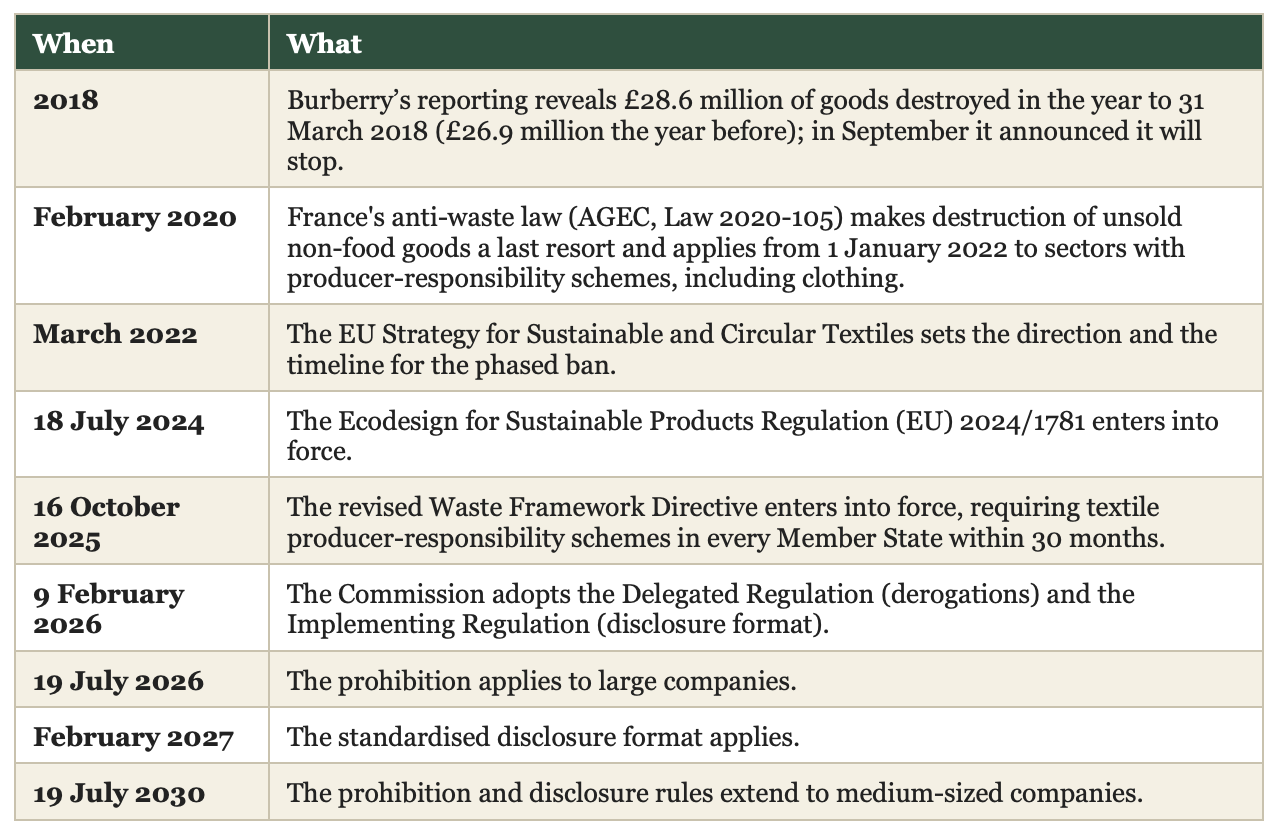
The ban is the culmination of multiple factors: public pressure on luxury brands, pioneering national regulations such as French AGEC, 2022 Textiles Strategy, and general revision of waste regulation in Europe.
The revision of the Waste Framework Directive, which has been in force since October 2025, introduces mandatory extended producer responsibility for textiles and footwear. The background is 12.6 million tonnes of textile waste generated in the EU in 2019, with only about 20% of it collected separately for reuse or recycling. And on 20 July 2026, the day after the ban started to apply, the Commission also announced that the central Digital Product Passport registry became operational, as part of the same framework of product traceability.
Trade views
The reaction of retailers welcomes the measure, while stressing its practical side. As commented Stefan Genth, the president of the German Retail Federation (HDE): “not all unsold goods can be resold or donated”, mentioning damaged packaging, logistical costs and low prices of products. The federation expects that consumers will see more discounts through outlets and resale.
What to look out for
- The capacity of the channels. Charities, social enterprises and resale platforms are now at the heart of the scheme, and their absorption capacity will determine how effective the measure will be.
- The enforcement. The national authorities are responsible for the inspections, and the Member States will establish their own penalties, so different practices will emerge at first.
- The first real figures. Standardized disclosures in February 2027 will allow seeing the first reported data about what large companies throw away, replacing the current 4-9% estimate.
- The step of 2030. Medium-sized companies will become bound by it in four years, and the exception of small and micro companies from the obligation leaves independent producers and brands out of it.
Sources
Primary references
- European Commission, New EU rules to stop the destruction of unsold clothes and shoes (9 February 2026)
- EUR-Lex, Regulation (EU) 2024/1781 (Ecodesign for Sustainable Products Regulation)
- European Commission, EU Strategy for Sustainable and Circular Textiles
- European Commission, Ban on destruction of unsold clothes and shoes enters into application (17 July 2026)
Supporting sources
- European Environment Agency, The destruction of returned and unsold textiles in Europe’s circular economy (March 2024)
- European Commission, Revised Waste Framework Directive enters into force (16 October 2025)
- European Commission, The Digital Product Passport Registry is now live (20 July 2026)
- Lewis Silkin, European Commission adopts new measures to stop unsold clothes and shoes being destroyed
- CMS, New EU rules to prevent the destruction of unsold textiles
- Cooley, Deep Dive: EU finalises new requirements for unsold consumer products under ESPR
- Freshfields, New EU Ecodesign rules for unsold consumer products
- Osborne Clarke, Prohibition on the destruction of unsold non-food products (France)
- CNBC, British fashion house Burberry to stop burning unsold items (6 September 2018)
- Deutsche Welle via The Business Standard, EU ban on destroying unsold clothes takes effect (20 July 2026)
Morgana Brennan, MBA
Morgana Brennan is a practicing Druid, Ogham Practitioner and Chief Magic Maker at Modern Druid, the gallery, apothecary, healing space, and event studio she founded at 60 South Broadway in Nyack, New York in 2021.
She holds a BSc in Economics and Business, a dual MBA in Management Systems and Information & Communication Systems, and an MIT certificate in Dynamic Work Design, and she brings her professional wizardry to other of her businesses consulting with and supporting independent healthcare practices.
Raised in Ireland and rooted in the Druid traditions of her homeland, she trained through OBOD and the Irish Pagan School. From that work she created her own Ogham intention oils and Morgana's Window, a divination practice read across a custom Fionn's Window table.
She gathers community the way an oak gathers birds. She founded DruidFest, hosts a monthly Druid Roundtable, opens Threshold Gatherings alongside fellow practitioners, and co-hosts the Modern Druid Podcast with her husband, Eric. The Modern Druid Promptuarium is her latest act of conjuring: a living periodical of doorways, each opening onto a different corner of the sacred.
Both lives run on the same magic. She takes what is tangled and complex, whether in the business of healthcare or an ancient tree alphabet, and turns it into something people can use. Every word, in her view, is abracadabra: as it is spoken, so it becomes.
 Modern Druid
Quarterly publication