Standing at the Threshold Between Life and Death: Reflections of a Funeral Director

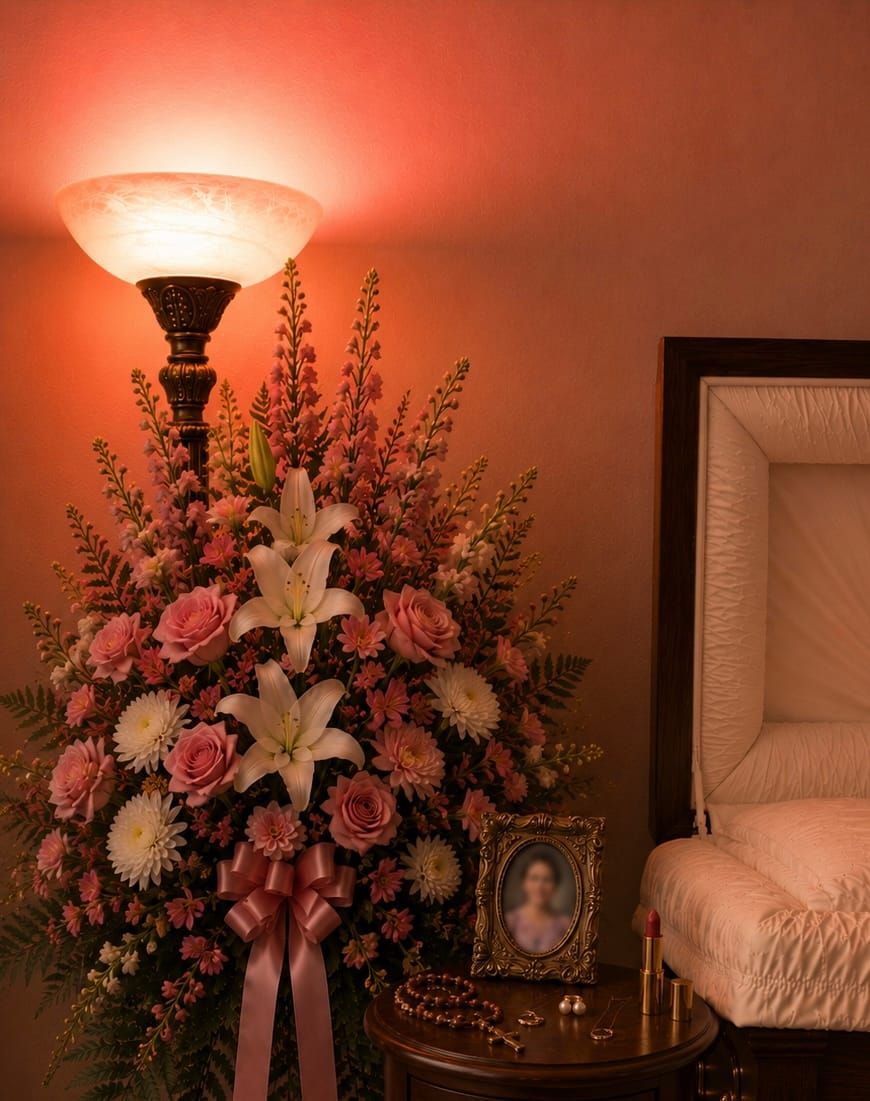
It is a Sunday evening in December, just before the holidays, and I stand in the doorway of the chapel at the funeral home where I work. I flip on the light switches and watch the room awaken. The silence is peaceful. Soft light from the torchieres casts a warm glow on either side of the polished mahogany casket.
I step into the room and begin arranging the fragrant floral tributes surrounding it. The scent of roses, lilies, cedar, and noble fir fills the space. Nestled among the flowers is a small mass card stand holding Mrs. Smith’s jewelry, her favorite lipstick, and a photograph her family entrusted to me.
Before placing the photograph inside the open casket, I pause to study it and take in every detail: the way she parted her hair, the gentle smile on her face, the way her hands rested around her favorite purse, a gift from her son while he was traveling through Europe. The photograph was taken at his wedding ten years earlier. She looks radiant. Looking at her, I cannot help but smile too.
I open my cosmetics case and carefully place an apron over Mrs. Smith’s stunning sequined gown, tucking it gently beneath her delicate hands resting peacefully across her abdomen. Selecting a foundation that matches her natural complexion, I smile and quietly say,
“Okay, Mrs. Smith… let’s doll you up for your big day. I promise you’re going to look like your beautiful self. Please don’t worry. You’re in good hands.”
For me, this is where every funeral begins, with care.
Becoming a New York State licensed funeral director and embalmer did not simply give me a profession—it gave shape to a calling that had been quietly unfolding within me for years. My purpose is simple: to help families grieve and heal while caring for their loved ones with dignity, restoring them as closely as possible to the natural appearance their families remember and cherish.
People often ask what a funeral director actually does. The answer is both simple and impossible. On any given day, I may be an event planner, an artist, a scientist, a guide, a celebrant, and, above all else, a caretaker.
Sometimes I am the first voice a family hears after the worst day of their lives. I travel to the place where their loved one has died and bring them into our care. I sit with families as they share stories, laughter, tears, photographs, and treasured memories while we plan a service that reflects a life well lived.
Behind the scenes, I prepare the person they love for one final gathering. Through embalming, restorative art, hairdressing, and cosmetics, I strive to restore not perfection, but familiarity. I want a husband to recognize his wife. A daughter to see her mother’s gentle expression. A great-grandchild to say, “That’s my GiGi.” I prepare legal documents, coordinate every detail of the funeral, and accompany families from the funeral home to their place of worship and, finally, to the cemetery or crematory.
Each responsibility carries technical precision, ethical obligation, and legal accountability. Yet none of those things matter without compassion. Every person entrusted to my care deserves to be treated as though they were my own loved one.
There is no room for ego in this profession.
Death has a way of stripping away everything that is unimportant. Titles, accomplishments, status, and pride become meaningless in the presence of profound loss. My work has taught me that the funeral director should never be the center of the story. We are simply entrusted with the privilege of walking beside families through one of the most sacred moments of their lives.
For me, funeral service is a calling. Those who hear that call understand that our purpose extends far beyond arranging funerals. We become witnesses to grief, guardians of dignity, and caretakers of love in its most vulnerable form.
And looking back, I realize that I have been walking beside death for as long as I can remember.
When I was three years old, my family couldn’t find me while we were visiting my grandparents’ house. My mother began calling my name as everyone searched from room to room until they heard my voice coming from my grandparents’ bedroom. Before coming to get me, they paused outside the door, listening. They wondered who I could possibly be talking to. Then they heard me say,
“Oh, Grandma… you look so beautiful in that dress.”
My grandmother had died the year before.
For my family, it became one of those stories that is told and retold through the years. For me, it became something else entirely for as I grew older, I realized I carried memories of my grandmother that I could not explain through ordinary experience. I have always sensed that my relationship with death was different. From childhood, I felt an awareness of something beyond what my eyes could see or my hands could touch. It was as though I naturally existed in the liminal space between the seen and the unseen, between what could be measured and what could only be experienced.
Those experiences quietly shaped the way I came to understand death. While many see death as an ending, I have always experienced it as a transition. I feel deeply grateful that my understanding of death has never been limited to what my five senses alone could perceive.
Yet my intuitive experiences were never the reason I became a funeral director. That calling arrived when I was fourteen years old.
A close friend had died, and when I saw him lying in his casket, I was devastated. Not only because I had lost someone I cared about, but because I could not understand why he had not been prepared with greater care. I noticed the details that had been overlooked. He had not been shaved. Bruising remained visible. The circumstances of his death seemed to speak louder than the life he had lived.
I was heartbroken.
But beneath the heartbreak I was angry that the body which had carried his life for only nineteen years had not been honored with the dignity I believed he deserved.
During the funeral procession, I turned to my best friend and quietly said, “If I ever become a funeral director, I promise every person I care for will be treated the way they should be.”
At fourteen years old, I thought I was making a promise. Years later, I realized I had heard my calling that day and I have spent my entire career keeping that promise, serving families with compassion and caring for their loved ones with the same dignity, respect, and love I would want for my own.
If there is one lesson that the dead have taught me more than any other, it is this: Love is transferable.
That may sound like an unusual statement, but after years of caring for families in the midst of profound loss, I have come to believe it with my whole heart.
When I meet with a family for the first time, one of the very first things I ask is, “Tell me about them.” Who were they? What made them laugh? What were they passionate about? What did they love? What is one memory that always makes you smile? Something extraordinary happens when families begin to answer those questions. The room changes. Tears often give way to laughter. Faces soften. For a few precious moments, grief steps aside and love begins telling the story.
As they speak, I find myself quietly falling in love with the person I never had the chance to meet. I begin to know the woman who never missed her grandchildren’s soccer games. The husband who whistled while making coffee every morning. The father who could fix anything. The sister whose laughter filled every room she entered. Their stories become my introduction. Their love becomes my connection.
I have come to believe that the love a family carries for someone does not stop with them. It is passed to me through every story, every photograph, every tear, every smile, and every cherished memory they entrust to my care. That love, in turn, becomes the love with which I care for their person. Being able to love someone I have never known is what I consider my superpower and it is what allows me to care for every person entrusted to me as though they were my own family.
And perhaps that is what the dead have taught me all along: that love does not end when a life ends. It simply asks someone else to carry it forward.
The chapel is quiet once again. Mrs. Smith is ready.
I gently remove the protective apron from her gown and smooth the fabric one final time. I place her rosary beads carefully into her resting hands, just as her family requested. After closing my makeup case and returning each brush to its place, I take one last look to be certain that everything is exactly as it should be.
I walk to the foot of her casket and switch off the torchiere. Then I make my way to the doorway of the chapel, just as I did when this evening began. One by one, I turn off the lights until only a single torchiere remains, casting its warm glow near the head of her casket.
I pause, taking in the stillness. The flowers. The quiet. The love that lingers in the room. Then, softly, I hear, “Thank you.”
Without surprise, I respond. “You’re welcome, Mrs. Smith.”
For a moment I simply stand there and smile, then gently close the chapel doors behind me.
Perhaps that is what it has always meant to stand at the threshold between life and death. Not to explain the mystery. But to meet it with reverence… and to answer it with love.
Quarterly publication