Celebrating Harvest Moon, Hong Kong-Style

Eimi OstaraMoon
I was born in Hong Kong, and grew up there during the 1980s... In those last days of being a British colony, people of Hong Kong celebrated a mix of British and traditional Chinese holidays. My absolute favorite of all of those holidays was – and still is – 中秋節 (zung1 cau1 zit3), which literally means Mid-Autumn Festival. You might also know it as "Moon Viewing Festival", "Mooncake Festival" or simply "Moon Festival". It happens on the fifteenth day of the eighth month in the Chinese lunisolar calendar, which is the day (night) of the full moon nearest to the Autumn Equinox. In Chinese lunisolar calendar, days of the month align with different moon phases: The first day of the month is New Moon; Full Moon is the fifteenth day; the month finishes its twenty-nine- or thirty-day cycle with Dark Moon. In Western folk and pagan traditions, the Mid-Autumn full moon is usually referred to as "Harvest Moon."
Some Background History
Chinese people have celebrated the harvest during the autumn full moon since the Shang dynasty (c. 1600–1046 BCE) 1. It has always been considered a time for family reunion and gatherings. Full moons, written as 圓月 or 滿月 in Chinese, symbolize the "completeness" (圓滿) of the household when all family members gather under one roof for holidays and celebrations. Mid-Autumn full moon is thought to be the fullest and brightest. By the Western Zhou dynasty (1046–771 BCE), "mid-autumn" (中秋) was mentioned for the first time in Rites of Zhou, a written collection of formal rituals and records of bureaucracy and organizational theory 2.
As an agrarian society, ancient Chinese worshiped the Moon, associating rejuvenation with the moon and water. They used phases of the moon, along with positions of the sun, to predict climate patterns and to plan for crop planting.
The Origin of Mid-Autumn Festival and Moon Worship
Chinese children are taught to make offerings to Chang'e 嫦娥 during Mid-Autumn Festival; her legend is the reason why we celebrate the brightest and fullest moon of the year.
As told in Lihui Yang's Handbook of Chinese Mythology 3, Chang'e was the wife of a hero named Hou Yi 后羿 who was an excellent archer in the ancient past, when there were ten suns. One year, the ten suns rose in the sky together, causing great sufferings to the people. Hou Yi shot down nine of the suns and left only one to provide warmth and light. An immortal admired Hou Yi and gave him the elixir of immortality. Hou Yi did not want to live forever without his wife, he let Chang'e keep the elixir. Peng Meng, one of Hou Yi's apprentices, knew this secret. On the fifteenth day of the eighth month, while Hou Yi was on a hunting expedition, Peng Meng broke into Hou Yi's house and forced Chang'e to give him the elixir. Chang'e refused, and she swallowed instead it and flew into the sky. Since she loved her husband and hoped to stay nearby, Chang'e chose the moon for her residence. When Hou Yi returned and found out what had happened, he was heartbroken. He set out fruits and cakes that Chang'e liked in the yard and gave offerings to his wife. As people learned about the tragic event and was moved by Chang'e's and Hou Yi's devotion to each other, they joined him and made their offerings to her as well. This version of Chang'e's legend explains why Mid-Autumn Festival is also associated with undying love and marriages. Young women often pray to Chang'e to help them fulfill their romantic wishes.
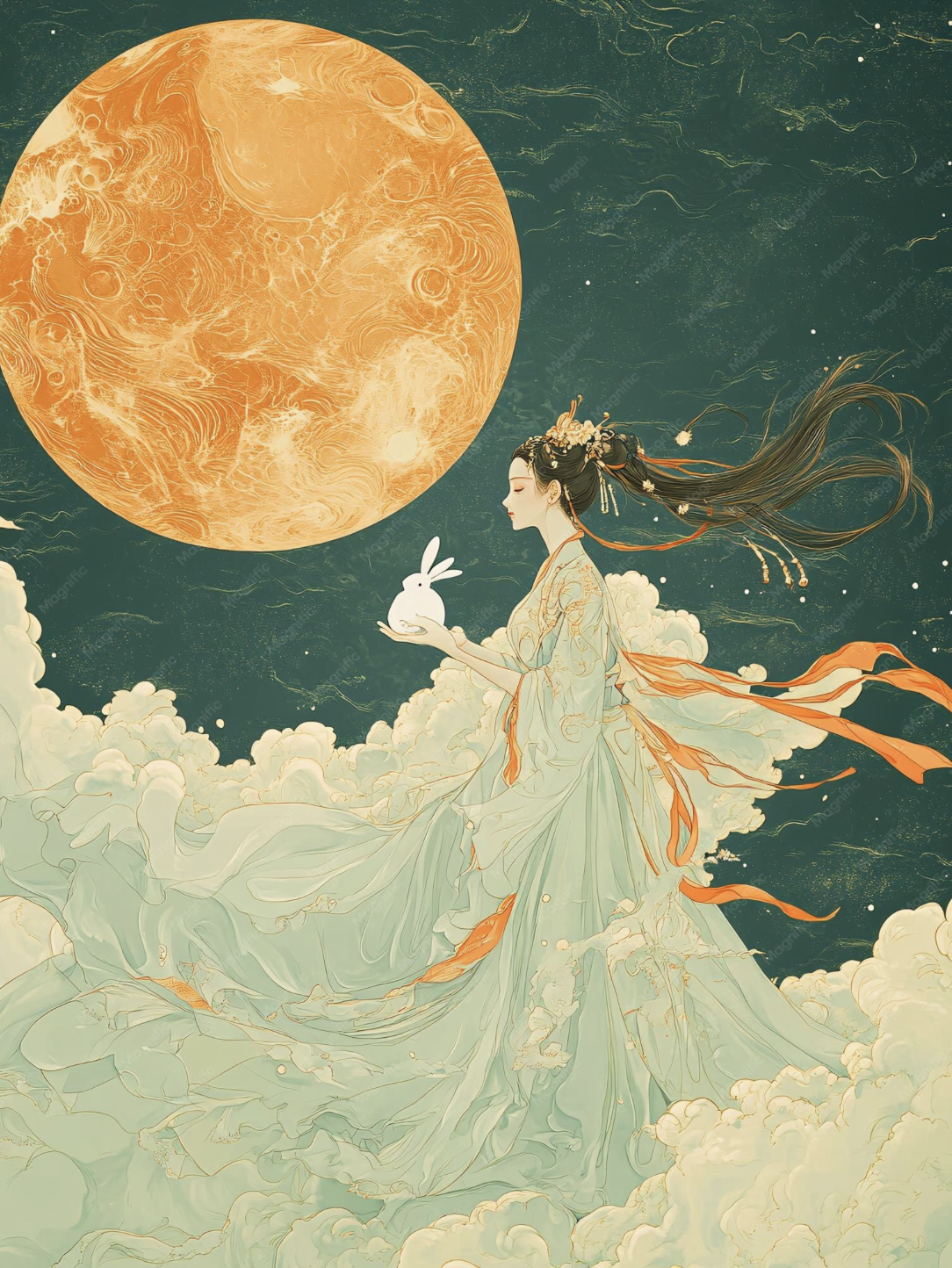
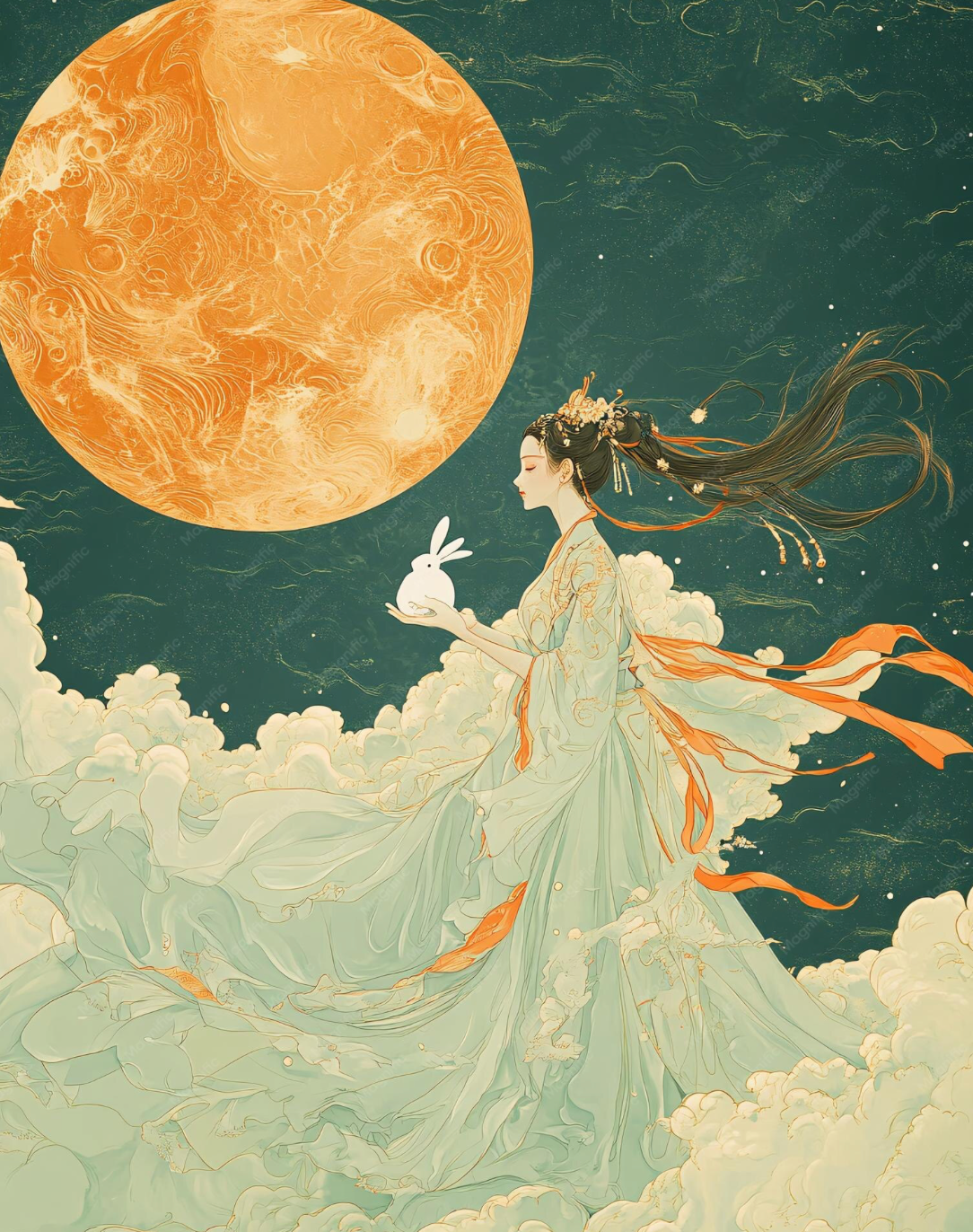
Lihui Yang also spoke of a less romantic version of the legend – the version that I personally am more familiar with. Legend has it that after the hero Hou Yi shot down the nine suns and relieved people of unbearable sufferings, he was crowned king by the grateful people. However, he was soon corrupted by power, and became a conceited and tyrannical ruler. He wanted to live forever, and asked Xiwangmu, Heavenly Queen Mother of the West, for the elixir of immortality. His wife Chang'e did not want the cruel king to become immortal and cause endless sufferings for the people, she stole the elixir on the fifteenth day of the eighth month and took it, becoming immortal herself. As Hou Yi became furious with Chang'e, and tried shooting at her but missed, Chang'e flew to the moon. She became the spirit of the moon, known as the Moon Goddess of Immortality. Hou Yi died soon after when he was overcome with great anger. Since then the people gave offerings to Chang'e on the fifteenth day of eighth month every year to commemorate her selfless sacrifice. In yet another variation of this version of the legend, Chang'e was holding a white rabbit as she flew to the moon. That white rabbit became her companion, Yutu 玉兔, the Jade Rabbit of the Moon.
Celebrating Mid-Autumn Festival
There are many region-specific local customs and traditions in celebrating Mid-Autumn Festival throughout Asia. Japan, Korea, Taiwan, Vietnam, and even different parts of China all have similar but different legends about Chang'e, the Jade Rabbit, and the Moon. Most celebrations involve gathering with family and friends, sharing foods and drinks, and having a merry time. Often moon-viewing is also practiced -- everyone sitting under the bright full moon and admiring her beauty, while partying it up, playing different games, and enjoying mooncakes and tea (or alcohol). Hong Kong has its own way to celebrate the holiday, and the way I remember celebrating it in the 1980s has its own unique flavor.
Two most important traditions for the Mid-Autumn Festival are lanterns and mooncakes. Brightly lit, colorful lanterns are as much of a signature part of the holiday as Christmas trees for Christmas. The original purpose of lanterns in connection with the festival is unclear, but it is certain that lanterns were not used in conjunction with Moon-worship prior to the Tang dynasty1. The custom might have been adopted from a different tradition. For example, Hong Kong fishermen during the Qing dynasty would put up lanterns on their boats as protection against restless spirits during the Ghost Festival, which is observed one month prior, and would keep the lanterns up until Mid-Autumn Festival1.
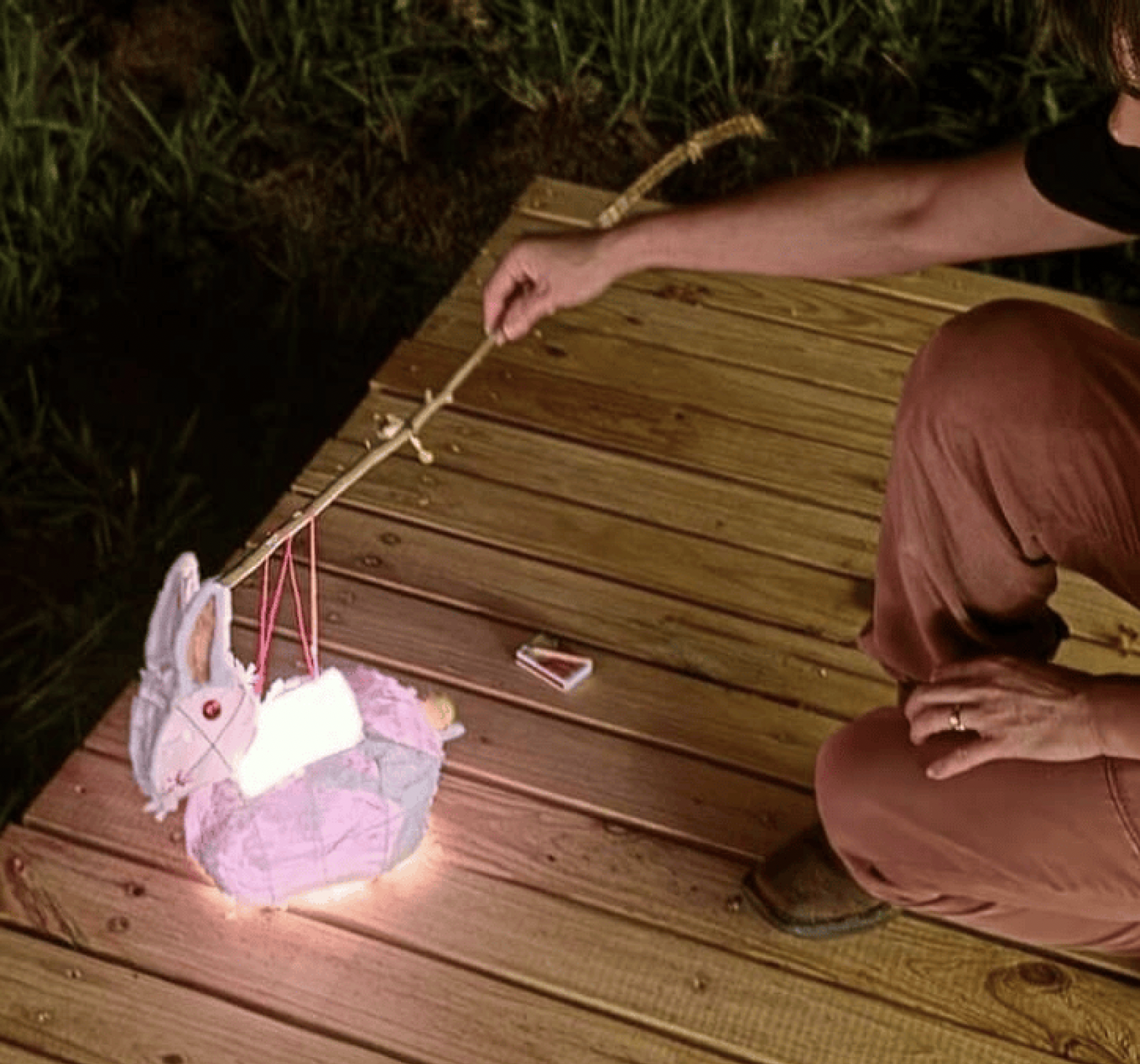
Usually about one month before the holiday, you will find lanterns of all sorts in toy shops, household item shops, grocery stores, stationary and office supply shops, and pop-up shops on streets. Back in my childhood days, there would be traditional accordion style paper lanterns – they fold up for easy storage and expand by pulling the top and the bottom away from each other. There were also paper mache ones in shapes of rabbits, star fruits, lotus flowers or stars, and the rabbit lanterns with wheels (more on that later) were usually most coveted. The lanterns were all candle-lit, so I actually learned to "play with fire" at a young age. As things got modernized in the mid-1980s and fire safety became more of a concern, plastic lanterns lit by battery-powered mini flashlights became more popular. Then came lanterns in the shapes of cute animals and popular cartoon characters, along with the traditional paper ones, now equipped with mini flashlights that flickered.
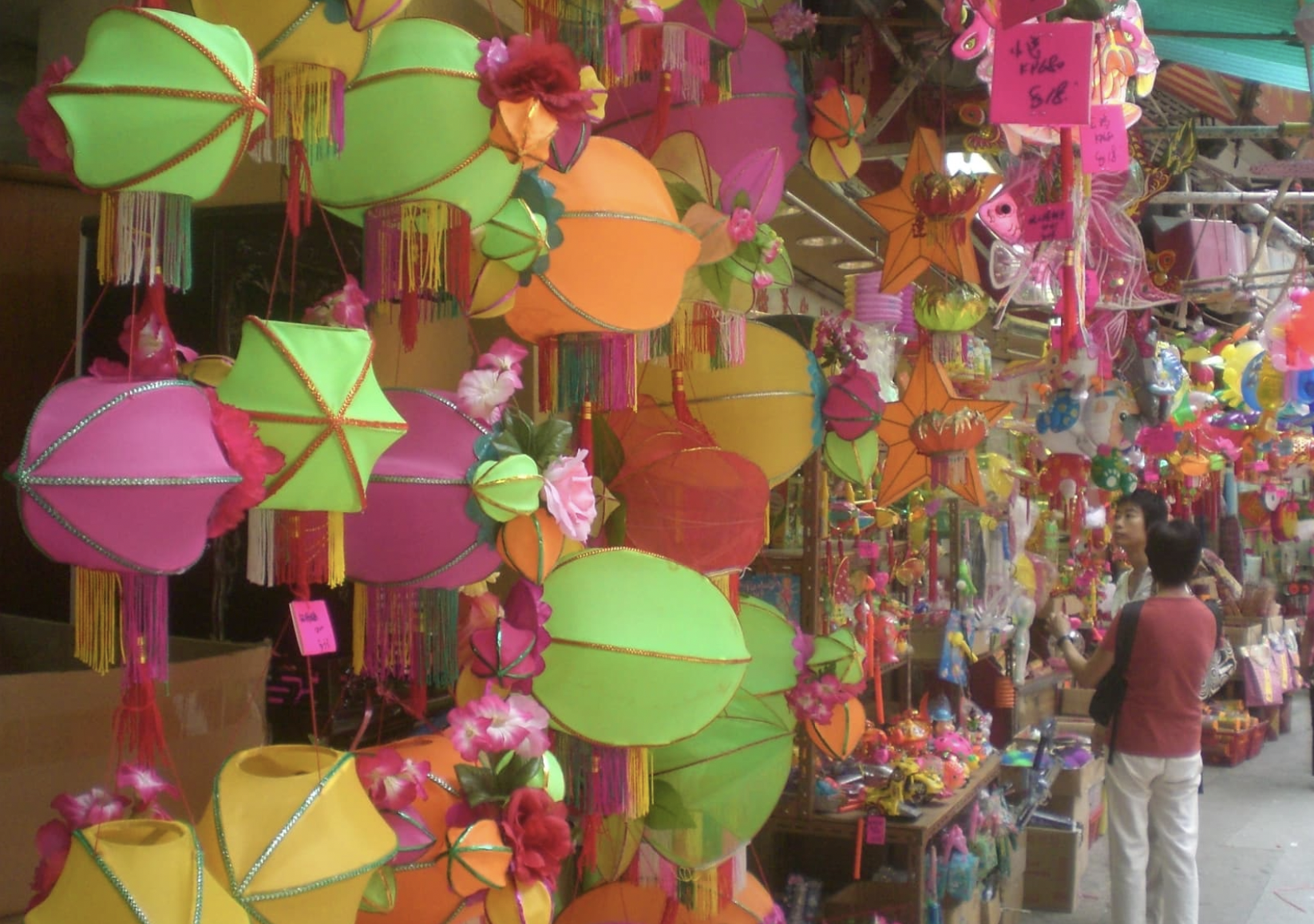
Getting your favorite lantern was a big deal. It was almost like a status symbol amongst youngsters – the more beautiful and elaborate the lantern you got, the cooler you were in the eyes of your neighborhood friends and rivals. As a child, I often eagerly waited for the Mid-Autumn evening to arrive, when my parents and grandfather would take me on a walk after dinner in the neighborhood or local park to show off my Garfield Cat lantern. If you had a rabbit lantern with wheels, you could take the rabbit for a drag. If you were to go old-school with a candle-lit paper lantern, walking around with what is now considered a fire hazard was a true test of stability and agility. Could you walk the whole block, as an excited five-year-old, without your lantern catching fire? And If you were taking your rabbit lantern for a drag, that was a boss level challenge. Most rabbit lanterns would not last more than 10 minutes, and I have yet to meet anyone who was able to keep their rabbit lantern till the end of the night. The streets were usually littered with rabbit lantern "skeletons" by 9 pm. Watching my rabbit lantern perish in a fiery inferno 3 minutes after lighting the candle as a five-year-old was a pretty traumatizing experience, I must admit...
The other Mid-Autumn Festival must-have is mooncake 月餅. Mooncake is a Chinese baked good consists of a thick, tender pastry skin enveloping a sweet, dense filling, and may contain one or several whole salted egg yolks in the center to symbolize the full moon. The filling can be lotus seeds paste, sweet bean paste, jujube paste, or five-kernels (mixed nuts) 5. Depending on the local customs, mooncakes may also be steamed or fried 6. China has several regional styles of mooncakes, Cantonese-style being the most famous and popular. Hong Kong people generally eats the Cantonese-style mooncakes, which use a variety of ingredients for fillings: lotus seed paste, melon seed paste, nuts, ham, chicken, duck, roast pork, mushrooms, egg yolks, etc. A more elaborate version contains four egg yolks, representing the four phases of the moon. And in the past two decades, Hong Kong has also invented its own unique style of mooncakes called "snow skin mooncakes" which have glutinous rice skin and ice-cream filling.
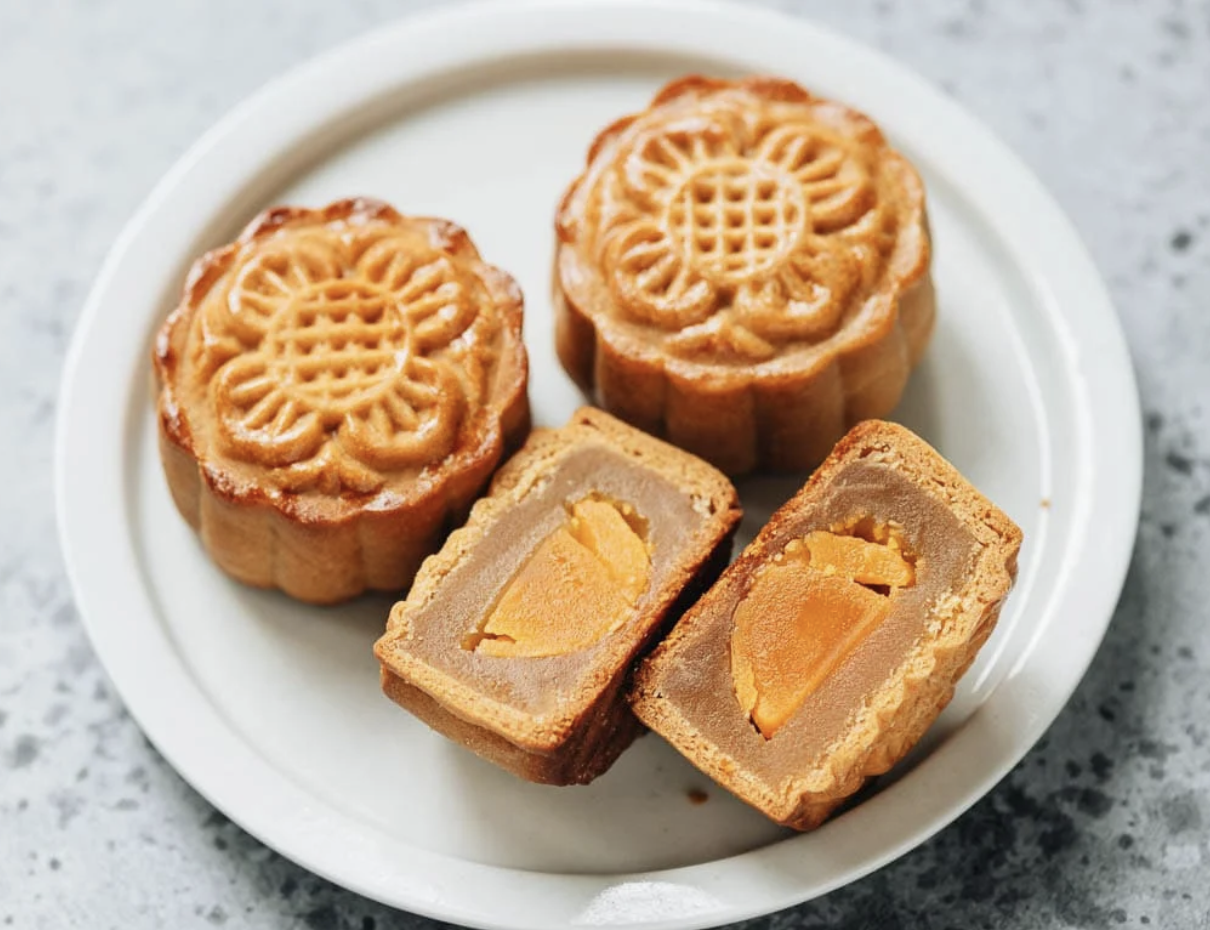
In Chinese culture, a round shape symbolizes completeness and reunion. The sharing and eating of round mooncakes among family members during the week of the festival signifies the completeness and unity of families. Making mooncakes used to be one of the hallmark traditions of Mid-Autumn Festival, but as time changes, most Hong Kong people purchase their mooncakes from pastry shops these days. There are several famous pastry shops specialize in making mooncakes, and people often wait in long lines to purchase their popular mooncakes. If anyone is interested in trying their hand at making mooncakes, there are some nice recipes readily available online, such as the one pictured above featured in Omnivores Cookbook: Traditional Mooncake (广式月饼) By Maggie Zhu.
Eating mooncakes is one of the Mid-Autumn customs that I am able to keep up with even after I moved to the United States, thanks to its common availability in the US. Most Asian stores, even small mom-and-pop shops, stock mooncakes seasonally. My favorite is the Cantonese-style with double-yolks and white lotus seed paste. As a child, I learned the legend behind the egg yolk(s) in mooncakes, and it had to do with the Han Chinese's uprising against the ruling Mongols at the end of the Yuan dynasty (1280–1368 CE). During their reign, the Mongols imposed strict controls upon Han Chinese families in which only one out of every ten households was allowed to own a knife, and it was guarded by a Mongolian. The Han Chinese had planned to rebel against the Mongols on Mid-Autumn Day, and used traditional mooncakes to conceal the message to gather as many available weapons as possible.
Only in Hong Kong: Tai Hang Fire Dragon Dance 11
Tai Hang 大坑, located on Hong Kong Island, used to be a small Hakka village of farmers and fishermen on the waterfront of Causeway Bay. Hakka is a Han Chinese sub-ethnic group whose principal settlements and ancestral homes are dispersed widely across the provinces of southern China. According to local legend, over a century ago, a few days before the Mid-Autumn Festival, a giant python entered the village and ate the village livestock. The villagers killed the python, but soon a plague broke out and took many lives. According to some villagers, the python was the son of the Dragon King, and the plague was the Dragon King's revenge against the villagers for killing his son. One of the village elders received a message from Guan Yin through a dream, telling him that the plague could be stopped by the villagers performing a fire dragon dance and setting off firecrackers around the village. The villagers following the instructions, and the plague disappeared miraculously. Since then, the villagers perform the ritual every year during the Mid-Autumn Festival to ward off plagues and misfortunes.
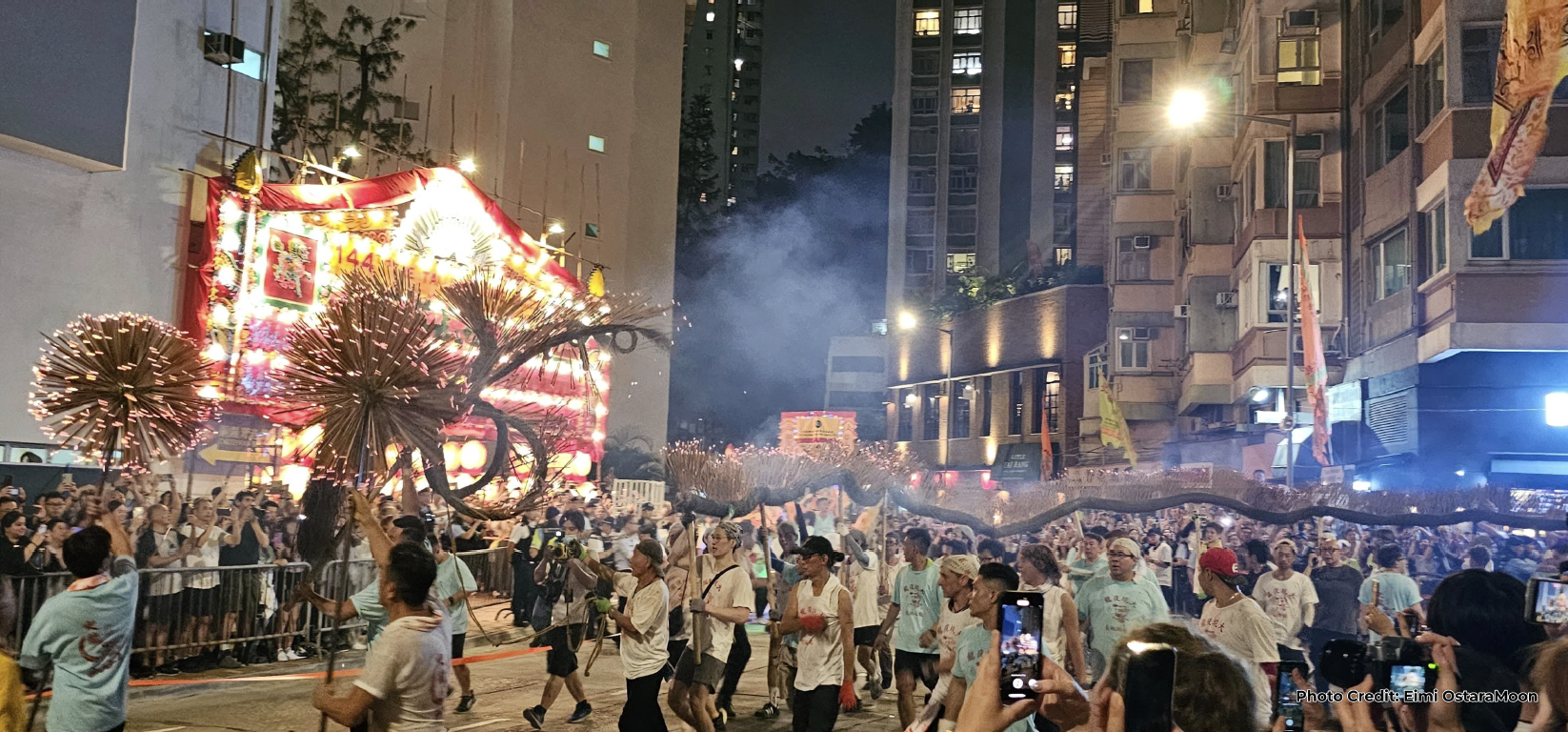
The Fire Dragon Dance Ceremony is held in Tai Hang for three nights during the Mid-Autumn Festival celebration, beginning on the fourteenth day and ending on the sixteenth day of the eighth month. The ritual features a 67-meter-long (220-foot-long) "fire dragon" woven from straw and rattan, and adorned with over 10,000 burning incense sticks. Approximately 300 performers carry the "fire dragon" through the narrow streets of Tai Hang and perform various stunts during the parade. Today, the Fire Dragon Dance Ceremony draws thousands of spectators; it is a ritual performed every year for almost 150 years since 1880, with only the exception of the period during the Japanese Occupation, the 1967 Hong Kong Riot, and the COVID-19 pandemic. The event is one of the Representative Works of Hong Kong's Intangible Cultural Heritage. I was fortunate enough to experience the Fire Dragon Dance Ceremony in person a few years ago. It was an unforgettable experience to watch the "fire dragon" weaving through the streets in an area that is only about 0.19 square miles, with thousands of people packed like canned sardines, burning incense sticks and firecrackers everywhere. Locals set up reveling parties along the streets, enjoying open-fire charcoal barbecue and getting drunk. It was insane, but it was a lot of fun.
My Own Family Mid-Autumn Traditions
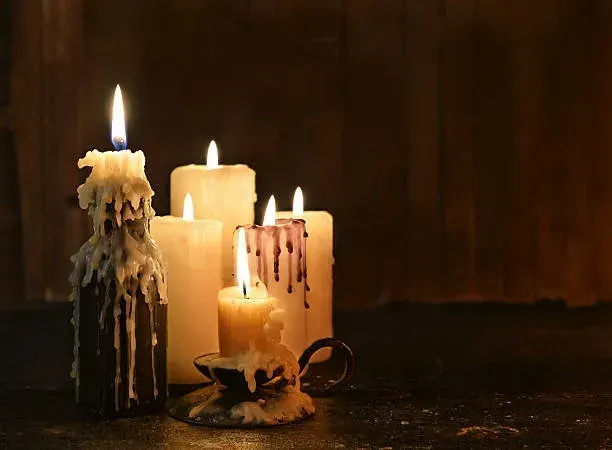
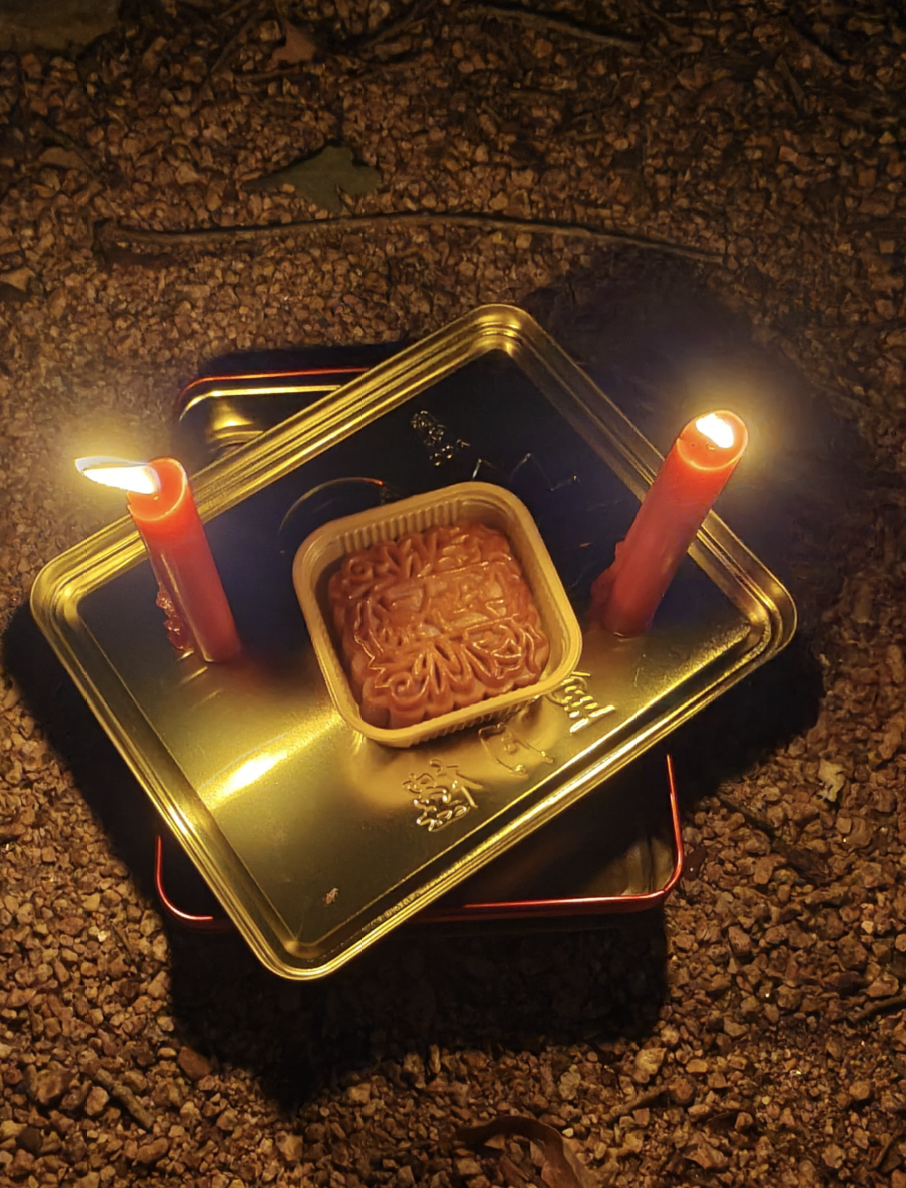
One of my favorite memories concerning Mid-Autumn Festival was moon-viewing with my immediate and extended family at the beach when I was about six or seven years old. My cousins and I ran around with our battery operated lanterns playing Tag. While the adults were chatting away, the kids were digging into the sand, creating "pits of hell" with an excessive amount of candles. We would also use the tin box in which the mooncakes came to melt down candles, creating a literal hot mess. Looking back, I believe that was my first foray into fire and candle magic. And all those early years of basking in the moonlight, playing with candles and fire, were clearly a prelude to my current magical practice where I do magic according to moon phases, cast candle spells regularly, and use fire for everything from cleansing to banishing to making offerings.
A Holiday Rich in Customs and Traditions
There are so many fun things to do and delicious things to eat during Mid-Autumn Festival that I have not even mentioned; things like giant lantern displays at popular public parks and Cantonese opera performances in temporary bamboo stages (another Hong Kong specialty). There are cassia and osmanthus wine, seasonal fruits such as apples, pomegranates, pears and pomelo, and glutinous rice balls with sweet sesame or peanut paste filling known as 湯丸 (tong1 jyun2). Celebrating Mid-Autumn Festival in Hong Kong is one of the things I miss about living in Hong Kong. Now as a grown-up witch living in the US, I try to do what I can to honor those childhood memories and celebrate the holiday the way I remember -- eat some mooncakes, do a candle spell or two and have a bonfire, while dancing under the brilliant glow of the moon. This year, I might take my rabbit lantern for a drag around the neighborhood.
Eimi OstaraMoon
A self-described misfit hailed from The Fragrant Harbor of the Pearl River, and the driving force behind Poison and Bee.
Poison and Bee grew out of Eimi's love for magical plants, especially the deadly ones, and honey bees. “Poison as medicine” is a concept she's always known, and honey bees became part of her magical practice naturally after she started her own apiary and working closely with them.
Following the guidance of plant allies and honey bees, Poison and Bee is an ever-changing adventure. You can find out more below.
Quarterly publication